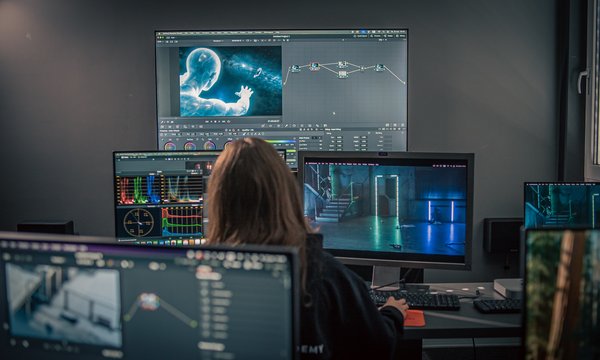
Course

Image Post-Production + AI

Course description

Image Post-Production + AI — Editing, VFX, Color Grading, and AI in Film Production.

Learn how to create a final image that cannot be achieved with a camera alone.

The Image Post-Production + AI program at AMA Kraków is a one-year, intensive program for people who want to enter the world of film editing, visual effects, color grading, and AI tools used in modern film, advertising, TV series, and online productions.

This is not a “prompting” course. It’s a hands-on course in creating the final image: from footage shot on set, through narrative editing, compositing, layer integration, color grading, clean-up, and set extensions, all the way to the strategic use of AI and generative video in a professional pipeline.

Depending on your chosen track, you’ll develop skills for roles such as: editor, junior VFX artist, compositor, colorist, roto/paint & cleanup artist, AI-assisted post-production artist, VFX supervisor’s assistant, or hybrid image creator for films, commercials, music videos, and new media.

VFX & AI Production

Image Post-Production + AI is a program at AMA Kraków that teaches students how to create a final image through post-production, compositing, visual effects, and working with AI.

Price for 2026 (first edition): 8,500 PLN
Standard price: 9,500 PLN

Limited enrollment—groups of 10.

In addition,

We have prepared special terms for those committed to pursuing their education at AMA. Candidates who pass the admissions process and sign a student contract by the end of June 2026 will receive a 30% discount on their final semester—as support during the final stage of their education.

Duration

1 year, 2 semesters. One semester consists of 8 sessions held every 2 weeks. Classes are held on Saturdays and Sundays from 10:00 a.m. to 6:00 p.m.

Start your education in this course

*]:pointer-events-auto scroll-mt-[calc(var(–header-height)+min(200px,max(70px,20svh)))]” dir=”auto” tabindex=”-1″ data-turn-id=”59cf439e-da22-4238-b68a-4f92bb691337″ data-testid=”conversation-turn-89″ data-scroll-anchor=”true” data-turn=”assistant”>

About the Program

Image Post-Production + AI is a program for people who want to create the final film image—through editing, visual effects, color grading, and AI tools. Contemporary films, commercials, TV series, and premium content are increasingly produced using a hybrid model: part of the image is captured on camera, part is created digitally, part is refined in post-production, and part is supported by AI.

At AMA, you’ll learn to understand this process as a whole. You’ll work with footage, explore narrative editing and film rhythm, compositing and layer integration, color correction and color grading, classic visual effects, clean-up, set extensions, the basics of VFX workflows, and AI tools used at every stage of video post-production.

What matters most is not the use of the effect itself, but control over the final image: the consistency of light, color, perspective, movement, quality, and narrative. That is why the program combines the classic foundations of post-production with new generative tools, teaching students how to use AI thoughtfully—as a support for the creative process, not as a substitute for cinematic thinking.

Graduates of this program are able to plan and execute a post-production project from raw footage to the final deliverable: edit footage narratively, build effects in layers, give the project a consistent color style, use AI where it speeds up the workflow, and prepare a portfolio and showreel. The program concludes with a capstone project and a theoretical exam.


What career paths does this major open up?

After completing the program, you can pursue entry-level and specialized roles in video post-production:

Junior VFX Artist — a person who prepares and produces simple and moderately complex VFX shots.

Compositor — a creator who combines multiple layers of imagery into a single cohesive shot: footage from the set, backgrounds, digital elements, and lighting and color corrections.

Roto / Paint / Cleanup Artist — a specialist in object removal, masking, rotoscoping, image restoration, and preparing shots for further work.

AI-assisted Postproduction Artist — a person who uses AI to speed up processes such as clean-up, inpainting, upscaling, denoising, reference generation, or frame extension.

VFX Supervisor Assistant — a person who assists with effects planning, documentation, shot lists, asset tracking, shot breakdowns, and communication between the set and post-production.

Hybrid visual artist — a specialist who combines footage with generative elements, CG, and compositing in commercials, music videos, short films, and new visual formats.

The AMA program covers topics such as data wrangling, matchmoving, VFX breakdowns, technical documentation, communication within the post-production team, building a showreel, and career paths in post-production.


Why is Image Post-Production + AI the profession of the future?

Contemporary productions are less and less likely to end at the filming stage. The final film is only created once the footage from the set is combined with editing, color grading, compositing, digital effects, clean-up, CG elements, set extensions, and—increasingly—AI tools.

Major film, TV series, advertising, and streaming productions need people who understand not only the tools but the entire process: how to edit footage, how to combine layers, how to maintain consistency in lighting, color, and perspective, how to evaluate the quality of the final result, and how to bring the project to its final delivery.

AI speeds up some aspects of the work, but it doesn’t replace creative decision-making. The people who will be most in demand are those who can combine a traditional understanding of imagery with new tools: they know when to use AI, when to fall back on compositing, and when an effect needs to be refined manually.


FAQ:

Will AI replace post-production work?
No. AI automates some tasks, but we still need someone who understands the image, monitors quality, merges layers, assesses the consistency of light and color, and takes responsibility for the final shot.

Is this a more technical or artistic field of study?
It’s a combination of both areas. You learn the technical post-production pipeline, but the goal is always the visual decision and the final on-screen effect.

Can I work in the film industry after completing this program?
This program prepares students for careers in editing, post-production, VFX, compositing, and hybrid imaging. Your first professional goals should be to build a portfolio and a showreel and to land junior or assistant positions.

How does Image Post-Production + AI differ from editing alone?
Editing shapes the film’s structure, rhythm, and narrative. Image + AI post-production takes it a step further—it refines individual shots and the final image: it removes, adds, combines, expands, and integrates visual elements, color, and effects.

Do you need to know about AI before you start?
You don’t need to be an AI expert. What’s more important is an interest in imagery, video, and post-production, as well as a willingness to work on projects.


Degree in VFX & AI Production

To complete the program and earn a diploma, students must complete a practical diploma project and pass a theoretical exam. Students who pass will receive an AMA FILM ACADEMY Diploma.

Program supported by the Polish Film Institute


Related courses

Operator + AI

A program focusing on cinematography, camera work, lighting, and contemporary camera operator workflows.

Visual Storytelling

A program focused on image design, visual storytelling, and thoughtful audiovisual form.

Film Directing + AI

A program focusing on cinematography, working with a crew, and modern production processes.

Image Post-Production + AI

A course on compositing, visual effects, AI, and the final film image.

Registration Guide

Registration begins on: April 15 , 2026

Recruitment begins on: May 5 , 2026

Course start date: October 13, 2026; end date: June 30, 2027

Exam fee: 250 PLN

Accident Insurance: 70 PLN

Entry fee: 1,900 PLN

Tuition: 8,500 PLN per semester / 17,000 PLN per year

Payable per semester in advance by October 1 and February 15 of each year

or in monthly installments due by the 5th of each month:

October–June: 1,750 PLN
July–September: 1,000 PLN

» We have prepared special terms for those who are committed to growing their careers at AMA.
Candidates who are accepted and sign a student contract by the end of June 2026 will receive a 30% discount on their final semester—as support during the final stage of their education.

The course will cover the following practical topics:

  • p]:pt-0 [&>p]:mb-2 [&>p]:my-0″>

    Layer-Based Workflow and Compositing — Combining Multiple Image Sources into a Cohesive Shot

  • p]:pt-0 [&>p]:mb-2 [&>p]:my-0″>

    Keying — the precise removal of the background from footage

  • p]:pt-0 [&>p]:mb-2 [&>p]:my-0″>

    Manual and computer-assisted rotoscoping — masking objects and characters frame by frame

  • p]:pt-0 [&>p]:mb-2 [&>p]:my-0″>

    2D and 3D Tracking — Tracking the Movement of Objects and the Camera Within a Shot

  • p]:pt-0 [&>p]:mb-2 [&>p]:my-0″>

    Matchmoving — recreating camera parameters for digital compositing

  • p]:pt-0 [&>p]:mb-2 [&>p]:my-0″>

    Color correction and color grading — from matching shots to establishing a visual style

  • p]:pt-0 [&>p]:mb-2 [&>p]:my-0″>

    Working with LUTs and look development — designing a consistent aesthetic for the project

  • p]:pt-0 [&>p]:mb-2 [&>p]:my-0″>

    Extending the plan and creating environments — building spaces beyond the physical frame

  • p]:pt-0 [&>p]:mb-2 [&>p]:my-0″>

    Digital matte painting — creating backgrounds and distant scenes as elements of a composition

  • p]:pt-0 [&>p]:mb-2 [&>p]:my-0″>

    Simulations — Basics of Fire, Smoke, and Water Effects

  • p]:pt-0 [&>p]:mb-2 [&>p]:my-0″>

    Integration of CG elements with footage

  • p]:pt-0 [&>p]:mb-2 [&>p]:my-0″>

    Preparing plates and organizing footage for visual effects

  • p]:pt-0 [&>p]:mb-2 [&>p]:my-0″>

    AI in Rotoscoping, Tracking, and Clean-Up — Tools That Automate Traditional Processes

  • p]:pt-0 [&>p]:mb-2 [&>p]:my-0″>

    Image Scaling and Noise Reduction Using AI

  • p]:pt-0 [&>p]:mb-2 [&>p]:my-0″>

    Inpainting and Generative Filling of Frame Areas

  • p]:pt-0 [&>p]:mb-2 [&>p]:my-0″>

    Text-to-video and image-to-video — generating video content

  • p]:pt-0 [&>p]:mb-2 [&>p]:my-0″>

    Creating Hybrid Shots — Combining Footage from the Set with Generative Elements

  • p]:pt-0 [&>p]:mb-2 [&>p]:my-0″>

    Prompt engineering for visual tools — precisely describing the desired image

  • p]:pt-0 [&>p]:mb-2 [&>p]:my-0″>

    Integrating Multi-Channel Renders — Working with Passes in Advanced Compositing

  • p]:pt-0 [&>p]:mb-2 [&>p]:my-0″>

    Building a VFX Showreel — Selecting Work and Showcasing Your Skills


The course will cover the following theoretical topics:

  • p]:pt-0 [&>p]:mb-2 [&>p]:my-0″>

    Formats, Codecs, and Color Spaces — Technical Fundamentals of Working with Film Footage

  • p]:pt-0 [&>p]:mb-2 [&>p]:my-0″>

    VFX Post-Production Pipeline — Stages, Roles, and Interdependencies Between Departments

  • p]:pt-0 [&>p]:mb-2 [&>p]:my-0″>

    The History and Context of Visual Effects — From Classic Techniques to Contemporary Hybrid Workflows

  • p]:pt-0 [&>p]:mb-2 [&>p]:my-0″>

    Color Theory — Scientific Principles and Their Application in Color Correction and Grading

  • p]:pt-0 [&>p]:mb-2 [&>p]:my-0″>

    Principles of visual coherence—spacing, perspective, and lighting as elements of effective integration

  • p]:pt-0 [&>p]:mb-2 [&>p]:my-0″>

    The Relationship Between Filmed, Processed, and Generated Images — How AI Fits Into the Tradition of Post-Production

  • p]:pt-0 [&>p]:mb-2 [&>p]:my-0″>

    Ethics and Copyright of AI-Generated Content — Ownership, Attribution, and Industry Regulations

  • p]:pt-0 [&>p]:mb-2 [&>p]:my-0″>

    VFX Supervision on Set — Planning Effects During Production, Documentation, Communication

  • p]:pt-0 [&>p]:mb-2 [&>p]:my-0″>

    VFX Budgeting and Cost Estimation — Resource and Time Planning in the Context of Production

Krystian Łochowski

Kajetan Czarnecki

Anna Giemzik

Przemysław Mastela

Krzysztof Hrycak

Tomasz Poznański

Michał Kowalski

Admission Requirements

To apply for admission to the VFX & AI Production program, you must take an entrance exam in the form of an interview. If you have work in the fields of film, photography, visual arts, or literature, you may present it during the interview—this is an added advantage, not a requirement.

We schedule interview dates with participants on an individual basis.

If you’d like, you can also send your resume or portfolio to the following email address: rekrutacja@amafilmacademy.pl.

» We’ve prepared special terms for those committed to pursuing their education at AMA.
Candidates who pass the admissions process and sign a student contract by the end of June 2026 will receive a 30% discount on their final semester—as support during the final stage of their education.

Registration Guide

Registration begins on: April 15 , 2026

Recruitment begins on: May 5 , 2026

Course start date: October 13, 2026; end date: June 30, 2027

Exam fee: 250 PLN

Accident Insurance: 70 PLN

Entry fee: 1,900 PLN

Tuition: 8,500 PLN per semester / 17,000 PLN per year

Payable per semester in advance by October 1 and February 15 of each year

or in monthly installments due by the 5th of each month:

October–June: 1,750 PLN
July–September: 1,000 PLN

» We have prepared special terms for those who are committed to growing their careers at AMA.
Candidates who are accepted and sign a student contract by the end of June 2026 will receive a 30% discount on their final semester—as support during the final stage of their education.

The course will cover the following practical topics:

  • p]:pt-0 [&>p]:mb-2 [&>p]:my-0″>

    Layer-Based Workflow and Compositing — Combining Multiple Image Sources into a Cohesive Shot

  • p]:pt-0 [&>p]:mb-2 [&>p]:my-0″>

    Keying — the precise removal of the background from footage

  • p]:pt-0 [&>p]:mb-2 [&>p]:my-0″>

    Manual and computer-assisted rotoscoping — masking objects and characters frame by frame

  • p]:pt-0 [&>p]:mb-2 [&>p]:my-0″>

    2D and 3D Tracking — Tracking the Movement of Objects and the Camera Within a Shot

  • p]:pt-0 [&>p]:mb-2 [&>p]:my-0″>

    Matchmoving — recreating camera parameters for digital compositing

  • p]:pt-0 [&>p]:mb-2 [&>p]:my-0″>

    Color correction and color grading — from matching shots to establishing a visual style

  • p]:pt-0 [&>p]:mb-2 [&>p]:my-0″>

    Working with LUTs and look development — designing a consistent aesthetic for the project

  • p]:pt-0 [&>p]:mb-2 [&>p]:my-0″>

    Extending the plan and creating environments — building spaces beyond the physical frame

  • p]:pt-0 [&>p]:mb-2 [&>p]:my-0″>

    Digital matte painting — creating backgrounds and distant scenes as elements of a composition

  • p]:pt-0 [&>p]:mb-2 [&>p]:my-0″>

    Simulations — Basics of Fire, Smoke, and Water Effects

  • p]:pt-0 [&>p]:mb-2 [&>p]:my-0″>

    Integration of CG elements with footage

  • p]:pt-0 [&>p]:mb-2 [&>p]:my-0″>

    Preparing plates and organizing footage for visual effects

  • p]:pt-0 [&>p]:mb-2 [&>p]:my-0″>

    AI in Rotoscoping, Tracking, and Clean-Up — Tools That Automate Traditional Processes

  • p]:pt-0 [&>p]:mb-2 [&>p]:my-0″>

    Image Scaling and Noise Reduction Using AI

  • p]:pt-0 [&>p]:mb-2 [&>p]:my-0″>

    Inpainting and Generative Filling of Frame Areas

  • p]:pt-0 [&>p]:mb-2 [&>p]:my-0″>

    Text-to-video and image-to-video — generating video content

  • p]:pt-0 [&>p]:mb-2 [&>p]:my-0″>

    Creating Hybrid Shots — Combining Footage from the Set with Generative Elements

  • p]:pt-0 [&>p]:mb-2 [&>p]:my-0″>

    Prompt engineering for visual tools — precisely describing the desired image

  • p]:pt-0 [&>p]:mb-2 [&>p]:my-0″>

    Integrating Multi-Channel Renders — Working with Passes in Advanced Compositing

  • p]:pt-0 [&>p]:mb-2 [&>p]:my-0″>

    Building a VFX Showreel — Selecting Work and Showcasing Your Skills


The course will cover the following theoretical topics:

  • p]:pt-0 [&>p]:mb-2 [&>p]:my-0″>

    Formats, Codecs, and Color Spaces — Technical Fundamentals of Working with Film Footage

  • p]:pt-0 [&>p]:mb-2 [&>p]:my-0″>

    VFX Post-Production Pipeline — Stages, Roles, and Interdependencies Between Departments

  • p]:pt-0 [&>p]:mb-2 [&>p]:my-0″>

    The History and Context of Visual Effects — From Classic Techniques to Contemporary Hybrid Workflows

  • p]:pt-0 [&>p]:mb-2 [&>p]:my-0″>

    Color Theory — Scientific Principles and Their Application in Color Correction and Grading

  • p]:pt-0 [&>p]:mb-2 [&>p]:my-0″>

    Principles of visual coherence—spacing, perspective, and lighting as elements of effective integration

  • p]:pt-0 [&>p]:mb-2 [&>p]:my-0″>

    The Relationship Between Filmed, Processed, and Generated Images — How AI Fits Into the Tradition of Post-Production

  • p]:pt-0 [&>p]:mb-2 [&>p]:my-0″>

    Ethics and Copyright of AI-Generated Content — Ownership, Attribution, and Industry Regulations

  • p]:pt-0 [&>p]:mb-2 [&>p]:my-0″>

    VFX Supervision on Set — Planning Effects During Production, Documentation, Communication

  • p]:pt-0 [&>p]:mb-2 [&>p]:my-0″>

    VFX Budgeting and Cost Estimation — Resource and Time Planning in the Context of Production

Krystian Łochowski

Kajetan Czarnecki

Anna Giemzik

Przemysław Mastela

Krzysztof Hrycak

Tomasz Poznański

Michał Kowalski

Admission Requirements

To apply for admission to the VFX & AI Production program, you must take an entrance exam in the form of an interview. If you have work in the fields of film, photography, visual arts, or literature, you may present it during the interview—this is an added advantage, not a requirement.

We schedule interview dates with participants on an individual basis.

If you’d like, you can also send your resume or portfolio to the following email address: rekrutacja@amafilmacademy.pl.

» We’ve prepared special terms for those committed to pursuing their education at AMA.
Candidates who pass the admissions process and sign a student contract by the end of June 2026 will receive a 30% discount on their final semester—as support during the final stage of their education.

Registration form

for the course:


Learn from the best!

AMA FILM ACADEMY