

Course description
Film Directing + AI is a one-year full-time program for those who want to lead an audiovisual project from concept to final product. The program develops practical skills in directing, scene work, working with actors, visual composition, and narrative structure, while also teaching students how to make visual decisions in a modern production environment. This program is for those who want not only to conceive ideas but also to consciously lead a project and take responsibility for its final form.
Film Directing + AI
Film Directing + AI is a one-year full-time program for those who want to lead an audiovisual project from concept to final product.
Price for 2026 (first edition): 7,900 PLN
Standard price: 8,900 PLN
Limited enrollment—groups of 10 students.
In addition,
We have prepared special terms for those committed to pursuing their education at AMA. Candidates who pass the admissions process and sign a student contract by the end of June 2026 will receive a 30% discount on their final semester—as support during the final stage of their education.
Duration
1 year, 2 semesters. One semester consists of 8 sessions held every 2 weeks. Classes are held on Fridays from 4:00 p.m. to 8:00 p.m. and on Saturdays and Sundays from 10:00 a.m. to 6:00 p.m.
Start your education in this course


About the Program
Film Directing + AI (Directing + AI) is a program for those who want to learn how to lead an audiovisual project in a thoughtful, modern, and responsible way. This is not the traditional model of film directing based solely on script interpretation and working with actors. This program focuses on guiding the entire creative process—from concept, through staging and cinematography, to the final product.
Today’s filmmakers are increasingly less likely to work exclusively within the traditional film industry framework. They must understand visuals, rhythm, narrative structure, post-production capabilities, and the impact of generative environments and AI tools on the production process. That is why the Film Directing + AI program develops not only directing skills but also the ability to make decisions within a new working model: what to shoot, what to generate, and how to maintain the project’s coherence from concept to final film.
This program is for people who want to influence the project as a whole. Not just writing or coming up with scenes, but actually bringing them to life on set, building a relationship with the actor, understanding the contemporary language of imagery, and making decisions that affect the final quality of a film, commercial, short film, online format, or hybrid project.
Who is this program for?
Film Directing + AI is for people who:
- want to pursue a career in directing and managing audiovisual projects,
- They want to consciously combine a traditional film set with a new production environment,
- They want to work on the staging, the narrative, the actors, and the visual structure of the project,
- They don’t want to limit themselves to the theory of directing, but want to work in a practical way,
- want to create films, commercials, short videos, online content, and hybrid projects,
- They want to develop their own work style and their own approach to managing projects.
This is a good program for people who want to develop their skills as directors in a way that aligns with the contemporary audiovisual market—both traditional and hybrid.
What You’ll Learn
During the program, you will develop skills related to managing an audiovisual project from the perspectives of directing, storytelling, and visual design. You will learn:
- build scenes and drive the narrative,
- write and develop a short film screenplay,
- analyze the material in terms of dramatic structure and rhythm,
- work with an actor and direct activities on set,
- translate an idea into a specific visual form,
- make decisions regarding the visuals, staging, and structure of scenes,
- work with the cinematographer, editor, sound engineer, and post-production team,
- plan the project in a consistent manner from development through final assembly,
- use AI and generative environments as part of the contemporary language of filmmaking,
- make informed decisions: when to film and when to create content.
The most important thing about this program is that you don’t just learn “how to direct,” but how to lead a project—taking responsibility for the meaning, form, pace, and quality of the whole.
What Is Learning Like?
The program is practical and project-based. This means that students do not limit themselves to theoretical exercises, but work on scenes, directing assignments, and their own projects. A key element of the program is developing decision-making skills within the actual creative process: during the preparation phase, on set, and while working on the final form of the material.
The program includes, among other things:
- cinematic language and visual grammar,
- screenwriting and playwriting,
- directing and working with actors on set,
- editing, sound, and post-production,
- development of directorial projects,
- work on communication with the team,
- understanding the contemporary model of directing in a hybrid environment: film set + generative video + post-production,
- preparing to enter the market, building a portfolio, and securing the first orders.
This program is for people who want to go beyond just the idea and learn how to take real responsibility for a project.
Learning Outcome
Upon completion of the program, students will:
- is able to consciously direct scenes and an audiovisual project,
- understands the relationship between directing, cinematography, editing, and post-production,
- makes creative decisions in a consistent and responsible manner,
- is able to develop their own project and communicate it to the team,
- can work in both the traditional and hybrid models,
- is establishing his own style as a director in the contemporary film industry.
Film Directing + AI is a program for those who want to be not only the creator of an idea, but a true leader of the creative process.
FAQ — Film Directing + AI, Kraków (on-campus)
How does the Film Directing + AI course differ from a traditional directing course?
Film Directing + AI isn’t based solely on script analysis and working with actors—though these elements are part of the curriculum. The key is managing the entire project: from concept, through production, to post-production and decision-making in a generative environment. You’ll learn to take responsibility for the final form of the project, not just for individual scenes.
What is “hybrid directing,” and why is it part of the curriculum?
Contemporary filmmaking increasingly combines footage shot on set with images generated by AI. Today, a director must know when to shoot and when to generate imagery—and how to maintain stylistic consistency between these two worlds. This is not a replacement for traditional directing, but rather an extension of it, incorporating new tools and new decisions.
Do you need to have previous directing experience?
It is not required, although this course is not an introductory course—it assumes an interest in storytelling, visual arts, and taking responsibility for a project. For those without prior filmmaking experience, we recommend taking “Visual Storytelling” first.
What does working with an actor in this program involve?
Working with actors is one of the pillars of the program: casting, rehearsals, scene development, directing on set, and guiding actors through their emotions. You learn not to instruct the actor, but to create the conditions in which the scene works—whether it’s a classic etude, a short film, or a hybrid project.
What career paths are available after completing this program?
Film Directing + AI paves the way for a career as a director of short films, commercials, music videos, online formats, and branded content. Graduates can also pursue careers in directing hybrid projects, where AI is part of the creative language, not just the end result.
What does the diploma entail, and how many projects do you need to complete?
The program culminates in the completion of three projects: a classical etude, a hybrid etude, and a graduation film presented publicly to an industry jury. In addition to the practical exam, there is a theoretical exam. Graduates receive an AMA Film Academy Diploma.
How does “Film Directing + AI” differ from “Directing-Cinematography”?
Film Directing + AI focuses on directing and project management. Directing-Cinematography is a dual-specialization program—it combines directing with cinematography in a single curriculum, designed for those who wish to develop both areas simultaneously. Film Directing + AI is recommended for those who want to focus on the role of the director and developing their own distinctive style of project management.
Degree in Film Directing + AI
To complete the course and earn a diploma, students must produce a classical etude, a hybrid etude, and a diploma film—which is presented to an audience during an open exam—and pass a theoretical exam. Students who pass the course receive an AMA FILM ACADEMY diploma.
A program supported by the Polish Film Institute

Related courses
AMA Future Filmmaking Lab
A year-long weekend program on AI, new technologies, and project-based work in film.
Editing (narrative editing)
A course on narrative editing, film rhythm, post-production, and working with AI

Film Directing + AI
A program focusing on cinematography, working with a crew, and modern production processes.
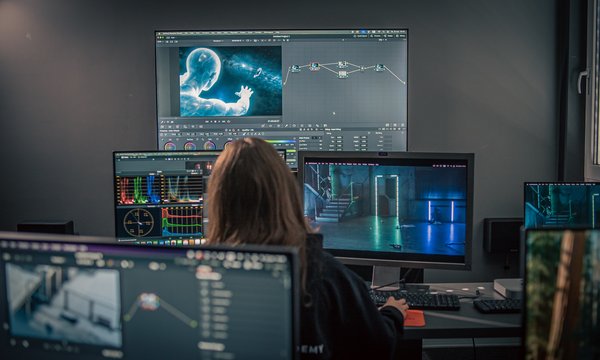
Image Post-Production + AI
A course on compositing, visual effects, AI, and the final film image.

Cinematography + AI
A program focusing on cinematography, camera work, lighting, and contemporary camera operator workflows.

Visual Storytelling
A program focused on image design, visual storytelling, and thoughtful audiovisual form.
Course curriculum
Registration Guide
Registration begins on: April 15 , 2026
Recruitment begins on: May 5 , 2026
Course start date: October 13, 2026; end date: June 30, 2027
Exam fee: 250 PLN
Accident Insurance: 70 PLN
Entry fee: 1,900 PLN
Tuition: 7,900 PLN per semester / 15,800 PLN per year
Payable per semester in advance by October 1 and February 15 of each year
or in monthly installments due by the 5th of each month:
October – June: 1,600 PLN
July–September: 1,000 PLN
» We have prepared special terms for those who are committed to growing their careers at AMA.
Candidates who are accepted and sign a student contract by the end of June 2026 will receive a 30% discount on their final semester—as support during the final stage of their education.
Practice
The course will cover the following practical topics:
- p]:pt-0 [&>p]:mb-2 [&>p]:my-0″>
Workshop-based analysis of film scenes
- p]:pt-0 [&>p]:mb-2 [&>p]:my-0″>
Film Dramaturgy and Screenwriting
- p]:pt-0 [&>p]:mb-2 [&>p]:my-0″>
working with actors — casting, rehearsals, directing on set
- p]:pt-0 [&>p]:mb-2 [&>p]:my-0″>
Direction of narrative scenes and staging
- p]:pt-0 [&>p]:mb-2 [&>p]:my-0″>
blocking and the actor–camera–space relationship
- p]:pt-0 [&>p]:mb-2 [&>p]:my-0″>
working with the crew on set — cinematographer, sound engineer, set designer
- p]:pt-0 [&>p]:mb-2 [&>p]:my-0″>
Filming the master shot and dialogue scenes
- p]:pt-0 [&>p]:mb-2 [&>p]:my-0″>
film editing and sound design
- p]:pt-0 [&>p]:mb-2 [&>p]:my-0″>
color correction and color grading
- p]:pt-0 [&>p]:mb-2 [&>p]:my-0″>
AI as an Element of Directing — Generative Video, Imagery, Pre-Production
- p]:pt-0 [&>p]:mb-2 [&>p]:my-0″>
Style and visual consistency checks in a generative environment
- p]:pt-0 [&>p]:mb-2 [&>p]:my-0″>
Directing a hybrid project — film set + generative environment
- p]:pt-0 [&>p]:mb-2 [&>p]:my-0″>
continuity between AI shots and footage from the set
- p]:pt-0 [&>p]:mb-2 [&>p]:my-0″>
“Camera” control in the generative world
<li class="py-0 my-0 prose-p:pt-0 prose-p:mb-2 prose-p:my-0 [&p]:pt-0 [&p]:mb-2 [&p]:my-0″>
Directorial Decisions: When to Shoot and When to Generate
<li class="py-0 my-0 prose-p:pt-0 prose-p:mb-2 prose-p:my-0 [&p]:pt-0 [&p]:mb-2 [&p]:my-0″>
AI in Editing, Post-Production, and VFX
<li class="py-0 my-0 prose-p:pt-0 prose-p:mb-2 prose-p:my-0 [&p]:pt-0 [&p]:mb-2 [&p]:my-0″>
Building a portfolio and showreel tailored to the real market
<li class="py-0 my-0 prose-p:pt-0 prose-p:mb-2 prose-p:my-0 [&p]:pt-0 [&p]:mb-2 [&p]:my-0″>
Performance of a Classical Etude
<li class="py-0 my-0 prose-p:pt-0 prose-p:mb-2 prose-p:my-0 [&p]:pt-0 [&p]:mb-2 [&p]:my-0″>
Production of a Hybrid Short Film
<li class="py-0 my-0 prose-p:pt-0 prose-p:mb-2 prose-p:my-0 [&p]:pt-0 [&p]:mb-2 [&p]:my-0″>
Production of a graduation film, followed by a presentation to an industry jury
Theory
The course will cover the following theoretical topics:
- p]:pt-0 [&>p]:mb-2 [&>p]:my-0″>
the grammar of film language
- p]:pt-0 [&>p]:mb-2 [&>p]:my-0″>
Film and Screenplay Analysis
- p]:pt-0 [&>p]:mb-2 [&>p]:my-0″>
The Basics of Dramaturgy and Film Structure
- p]:pt-0 [&>p]:mb-2 [&>p]:my-0″>
aesthetics and the poetics of imagery
- p]:pt-0 [&>p]:mb-2 [&>p]:my-0″>
AI in the Language of Filmmaking — Fake Realism vs. Cinematic Realism, Generative Dramaturgy
- p]:pt-0 [&>p]:mb-2 [&>p]:my-0″>
AI limitations as a conscious creative decision
- p]:pt-0 [&>p]:mb-2 [&>p]:my-0″>
Trade-offs in hybrid production — cost, time, quality
- p]:pt-0 [&>p]:mb-2 [&>p]:my-0″>
audiovisual market — content, advertising, branded content, online formats
- p]:pt-0 [&>p]:mb-2 [&>p]:my-0″>
Copyright and Ethics in Generative Content
- p]:pt-0 [&>p]:mb-2 [&>p]:my-0″>
hybrid film production workflow
Faculty Members in the Following Programs
- Grzegorz Zariczny
- Bartosz Blaschke
- Jacob Chełkowski
- Mariusz Sykut
- Aleksandra Takuska
- Piotr Lenar
- Michał Sosna
- Maciej Gil
- Piotr Zdybał
- Piotr Lenar
- Patryk Jordanowicz
- Anna Giemzik
- Przemysław Mastela
- Jarosław Migoń
Admission Requirements
To be admitted to the Film Directing + AI program, applicants must participate in an interview and, optionally, submit a portfolio.
We schedule interview dates with participants on an individual basis.
Please send your resume and portfolio to the following email address: rekrutacja@amafilmacademy.pl
» We’ve prepared special terms for those committed to pursuing their education at AMA.
Candidates who pass the admissions process and sign a student contract by the end of June 2026 will receive a 30% discount on their final semester—as support during the final stage of their education.
Registration Guide
Registration begins on: April 15 , 2026
Recruitment begins on: May 5 , 2026
Course start date: October 13, 2026; end date: June 30, 2027
Exam fee: 250 PLN
Accident Insurance: 70 PLN
Entry fee: 1,900 PLN
Tuition: 7,900 PLN per semester / 15,800 PLN per year
Payable per semester in advance by October 1 and February 15 of each year
or in monthly installments due by the 5th of each month:
October – June: 1,600 PLN
July–September: 1,000 PLN
» We have prepared special terms for those who are committed to growing their careers at AMA.
Candidates who are accepted and sign a student contract by the end of June 2026 will receive a 30% discount on their final semester—as support during the final stage of their education.
Practice
The course will cover the following practical topics:
- p]:pt-0 [&>p]:mb-2 [&>p]:my-0″>
Workshop-based analysis of film scenes
- p]:pt-0 [&>p]:mb-2 [&>p]:my-0″>
Film Dramaturgy and Screenwriting
- p]:pt-0 [&>p]:mb-2 [&>p]:my-0″>
working with actors — casting, rehearsals, directing on set
- p]:pt-0 [&>p]:mb-2 [&>p]:my-0″>
Direction of narrative scenes and staging
- p]:pt-0 [&>p]:mb-2 [&>p]:my-0″>
blocking and the actor–camera–space relationship
- p]:pt-0 [&>p]:mb-2 [&>p]:my-0″>
working with the crew on set — cinematographer, sound engineer, set designer
- p]:pt-0 [&>p]:mb-2 [&>p]:my-0″>
Filming the master shot and dialogue scenes
- p]:pt-0 [&>p]:mb-2 [&>p]:my-0″>
film editing and sound design
- p]:pt-0 [&>p]:mb-2 [&>p]:my-0″>
color correction and color grading
- p]:pt-0 [&>p]:mb-2 [&>p]:my-0″>
AI as an Element of Directing — Generative Video, Imagery, Pre-Production
- p]:pt-0 [&>p]:mb-2 [&>p]:my-0″>
Style and visual consistency checks in a generative environment
- p]:pt-0 [&>p]:mb-2 [&>p]:my-0″>
Directing a hybrid project — film set + generative environment
- p]:pt-0 [&>p]:mb-2 [&>p]:my-0″>
continuity between AI shots and footage from the set
- p]:pt-0 [&>p]:mb-2 [&>p]:my-0″>
“Camera” control in the generative world
<li class="py-0 my-0 prose-p:pt-0 prose-p:mb-2 prose-p:my-0 [&p]:pt-0 [&p]:mb-2 [&p]:my-0″>
Directorial Decisions: When to Shoot and When to Generate
<li class="py-0 my-0 prose-p:pt-0 prose-p:mb-2 prose-p:my-0 [&p]:pt-0 [&p]:mb-2 [&p]:my-0″>
AI in Editing, Post-Production, and VFX
<li class="py-0 my-0 prose-p:pt-0 prose-p:mb-2 prose-p:my-0 [&p]:pt-0 [&p]:mb-2 [&p]:my-0″>
Building a portfolio and showreel tailored to the real market
<li class="py-0 my-0 prose-p:pt-0 prose-p:mb-2 prose-p:my-0 [&p]:pt-0 [&p]:mb-2 [&p]:my-0″>
Performance of a Classical Etude
<li class="py-0 my-0 prose-p:pt-0 prose-p:mb-2 prose-p:my-0 [&p]:pt-0 [&p]:mb-2 [&p]:my-0″>
Production of a Hybrid Short Film
<li class="py-0 my-0 prose-p:pt-0 prose-p:mb-2 prose-p:my-0 [&p]:pt-0 [&p]:mb-2 [&p]:my-0″>
Production of a graduation film, followed by a presentation to an industry jury
Theory
The course will cover the following theoretical topics:
- p]:pt-0 [&>p]:mb-2 [&>p]:my-0″>
the grammar of film language
- p]:pt-0 [&>p]:mb-2 [&>p]:my-0″>
Film and Screenplay Analysis
- p]:pt-0 [&>p]:mb-2 [&>p]:my-0″>
The Basics of Dramaturgy and Film Structure
- p]:pt-0 [&>p]:mb-2 [&>p]:my-0″>
aesthetics and the poetics of imagery
- p]:pt-0 [&>p]:mb-2 [&>p]:my-0″>
AI in the Language of Filmmaking — Fake Realism vs. Cinematic Realism, Generative Dramaturgy
- p]:pt-0 [&>p]:mb-2 [&>p]:my-0″>
AI limitations as a conscious creative decision
- p]:pt-0 [&>p]:mb-2 [&>p]:my-0″>
Trade-offs in hybrid production — cost, time, quality
- p]:pt-0 [&>p]:mb-2 [&>p]:my-0″>
audiovisual market — content, advertising, branded content, online formats
- p]:pt-0 [&>p]:mb-2 [&>p]:my-0″>
Copyright and Ethics in Generative Content
- p]:pt-0 [&>p]:mb-2 [&>p]:my-0″>
hybrid film production workflow
Faculty Members in the Following Programs
- Grzegorz Zariczny
- Bartosz Blaschke
- Jacob Chełkowski
- Mariusz Sykut
- Aleksandra Takuska
- Piotr Lenar
- Michał Sosna
- Maciej Gil
- Piotr Zdybał
- Piotr Lenar
- Patryk Jordanowicz
- Anna Giemzik
- Przemysław Mastela
- Jarosław Migoń
Admission Requirements
To be admitted to the Film Directing + AI program, applicants must participate in an interview and, optionally, submit a portfolio.
We schedule interview dates with participants on an individual basis.
Please send your resume and portfolio to the following email address: rekrutacja@amafilmacademy.pl
» We’ve prepared special terms for those committed to pursuing their education at AMA.
Candidates who pass the admissions process and sign a student contract by the end of June 2026 will receive a 30% discount on their final semester—as support during the final stage of their education.
Learn with us. Explore the world of film!
Get inspired by film and learn from the best. Gain a modern profession and work professionally in the film industry. Check the current enrolment.
Enrol at AMA