

AI Filmmaking at AMA
AI in Film—A New Generation of Film School
Film, camera, lighting, editing, VFX, post-production, and generative AI are becoming a single process. At AMA Film Academy, we teach how to use AI thoughtfully in filmmaking: from concept, through storyboarding and pre-visualization, to the final image, sound, and distribution.
This page answers the following questions: What is AI in film? Where can you study AI filmmaking in Poland? What is an AI film school like? How does AI filmmaking differ from VFX? And what programs does AMA Film Academy offer in Kraków, Warsaw, and online?
| Check out the admissions process | See AI programs |
Video
AI Filmmaking in Practice
Watch the videos and examples of image editing. This section demonstrates that AI in film at AMA is an integral part of practical film education, image editing, VFX, and post-production.
Definition
What Is AI in Film?
AI in film refers to the use of artificial intelligence at various stages of audiovisual production: in research, screenwriting, mood boards, storyboarding, pre-visualization, animation, VFX, compositing, editing, color grading, sound, dubbing, subtitles, and distribution.
In practice, the prompt itself isn’t the most important thing. What matters most is cinematic thinking: drama, composition, lighting, rhythm, editing, working with actors, stylistic control, and directorial decisions. That’s why AMA Film Academy teaches AI not as a magic generator, but as a creative tool that requires cinematic awareness.
AI can speed up the process, reduce development costs, help test scenes before filming begins, and expand the capabilities of small crews. But it’s still the human who decides what makes sense, what resonates emotionally, and what constitutes a film.
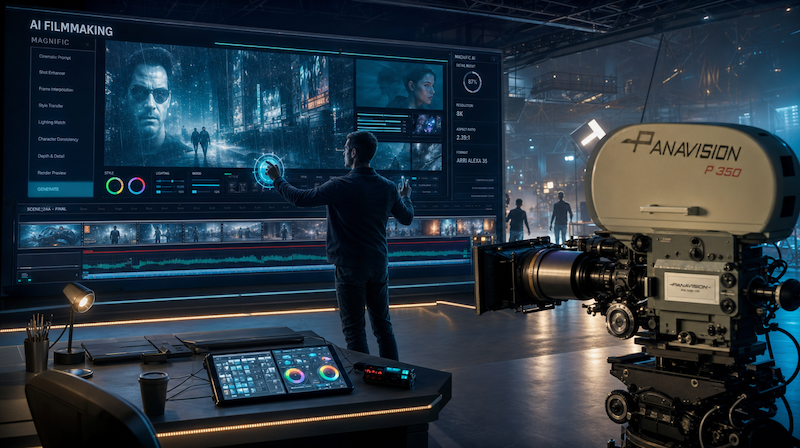
TRADITIONAL AND COMPUTER-GENERATED FILM
The AMA Approach
First, the video. Then, the tools.
Cinematic ThinkingAMA students learn about scene, conflict, rhythm, composition, working with actors, lighting, color, editing, and sound. It is only on this foundation that we build AI skills. |
Manufacturing ProcessAI isn’t a separate world detached from filmmaking. At AMA, it’s integrated into the actual workflow: development, pre-production, filming, post-production, VFX, versioning, and promotion. |
Practical ProjectsAMA teaches through hands-on work on visuals and projects, rather than through presentations of tools that are disconnected from production. Technology is meant to serve the story, not the other way around. |
Workflow
How Is AI Being Integrated Into Film Production?
Contemporary film production is increasingly adopting a hybrid approach. Traditional cinematography, camera work, on-set production, and post-production are being combined with AI tools. At AMA, we teach how artificial intelligence can support every stage of a filmmaker’s work.
DevelopmentResearch, film analysis, mood boards, visual references, style tests, and generating image variations. |
Pre-productionStoryboards, previs, scene tests, camera movement, set design, lighting, and visual consistency design prior to filming. |
ProductionFilm script, camera work, source material, generative elements, shot analysis, and preparation for post-production. |
Post ProductionVFX, compositing, rotoscoping, upscaling, computer-assisted editing, color grading, sound, language versions, and distribution. |
Fields of Study
AMA Topics Related to AI in Film
Four tracks that integrate AI with the traditional skills specific to each specialization. These are links to actual programs at AMA Film Academy.
VFX & AI ProductionPost-production, compositing, visual effects, generative imagery, ComfyUI, Runway, After Effects, DaVinci Resolve Fusion, and a pipeline that integrates on-set footage with synthetic layers. |
Cinematography + AICamera, lighting, framing, movement, color, post-production, and AI as an extension of the cinematographer’s toolkit. A program for future cinematographers and visual artists. |
Directing + AIDirecting, working with actors, designing the film’s world, scene rehearsals, pre-visualization, and overall responsibility for the hybrid production. |
AMA Future Filmmaking LabA project program for creators who want to explore the future of production: generative video, node-based workflows, virtual production, and film experiments. |

-
- STUDENCI AMA
-
- STUDENCOI AMA
Competencies
What do you learn at AMA?
Depending on their major and program, AMA students work in areas such as: directing in the world of AI, visual storytelling, cinematography and lighting in a hybrid workflow, generative video, VFX/AI, compositing, image post-production, AI in editing, previsualization, prompt engineering for film, ComfyUI, node-based workflows, visual style control, character and world consistency, AI in audio, sound design, AI ethics, and copyright law.
The most important thing, however, is that all these tools are subordinate to the film. Technology is meant to serve the story, not to replace meaning, emotion, and creative decision-making.
Krakow / Warsaw / online
Where can I learn about AI in film?
AMA KrakowThe AMA Film Academy in Kraków is expanding its programs in AI, VFX, post-production, and visual storytelling. It’s an important institution for those looking for a hands-on film school that offers courses in AI, generative video, and post-production workflows. Local search terms: film school Kraków AI, AI filmmaking Kraków, AI course in film Kraków, VFX AI Kraków. |
AMA WarsawThe AMA Film Academy in Warsaw combines traditional filmmaking techniques with new technologies: directing, cinematography, acting, editing, sound, and AI in the production process. Local search terms: film school Warsaw AI, AI in film course Warsaw, AI film Warsaw. |
New Roles
What careers does AI filmmaking open up?
AI filmmaking is opening up new roles and specializations: AI Film Director, AI Visual Developer, Generative Video Artist, VFX/AI Artist, AI Compositor, Film Prompt Designer, AI Previs Artist, Virtual Production Assistant, Post-Production AI Specialist, and Creative Technologist in film production.
This does not mean the end of traditional professions. On the contrary: those who understand traditional film and know how to use new tools will be in the best position.
AI Film DirectorA director who understands traditional filmmaking techniques, AI previs, generative video, and hybrid production. |
AI Visual DeveloperThe artist responsible for the visual style, mood boards, style tests, and the consistency of the film’s world. |
VFX/AI ArtistAn artist who combines compositing, visual effects, generative art, and traditional post-production. |
Generative Video ArtistA tool for creating generative images, text-to-video, image-to-video, and video-to-video content. |
Previs Artist AIA person who creates storyboards, scene tests, camera movements, and pre-visualizations using AI. |
Creative TechnologistA creator who combines technical expertise, AI pipelines, storytelling, style, and production practices. |
Recruitment
Access the new video workflow
If you want to create visuals in a world where camera work, editing, VFX, post-production, and AI are becoming a single process, start with AMA Film Academy.
Check out the 2026/2027 admissions processContact the office
Linking
Read more
Education at AMA
About the School
Admissions
AI in Film – Hub
What is AI filmmaking?
AI in Film Education
One Movie Project
FAQ
AI in Film and the AMA Film Academy
Will AI replace filmmakers?
No. AI changes tools and workflows, but a film still needs creators who are responsible for the meaning of a scene, its emotion, rhythm, visuals, and artistic decisions.
What is AI filmmaking?
AI filmmaking is an approach to audiovisual production in which generative AI tools are integrated into the traditional filmmaking process.
How is AI filmmaking different from VFX?
VFX is a broad field encompassing visual effects and compositing. AI filmmaking uses generative models to create and enhance visuals, sound, and the production process. In practice, these two fields are increasingly converging.
What AI programs does AMA offer?
AMA is developing programs and tracks related to VFX & AI Production, Cinematography + AI, Directing + AI, and the AMA Future Filmmaking Lab.
Where can you study AI in film in Poland?
AMA Film Academy offers film education incorporating AI in Kraków, Warsaw, and online.
Do you need to know how to program?
Not at the beginning. It’s more important to understand the image, the film, and the creative process. Technical workflows, such as ComfyUI and node-based pipelines, develop gradually.
Does AMA only teach AI tools?
No. AMA focuses primarily on filmmaking. AI tools are part of a broader curriculum that covers directing, cinematography, lighting, editing, VFX, post-production, screenwriting, and production.